

Daily Vocal Riyaz & Harmonium Fingering Guide (गायन एवं हारमोनियम रियाज़ मार्गदर्शिका)
Consistent, disciplined daily practice (Riyaz) is the foundation of Hindustani classical music. Whether you are learning vocal music or harmonium for Prarambhik and Praveshika examinations, following proper posture, breath control, and finger placement prevents bad habits early on.
1. Daily Vocal Riyaz Rules (गायन रियाज़ के नियम)
-
Correct Sitting Posture: Always sit upright with your spine straight in Sukhasana or Padmasana on a flat surface. Keep your shoulders, neck, and jaw completely relaxed so your voice resonates freely without strain.
-
Morning Kharaj Practice (ख़रज का अभ्यास): Begin your morning session with a Tanpura or harmonium drone, singing sustained Om or Aakar (“Aa”) on the lower notes from Madhya Sa down to Mandra Pa. Practicing in the Mandra Saptak builds vocal depth, steadiness, and resonance.
-
Three-Tempo Alankar Practice: Practice Shuddha Swara Alankars (note patterns) for at least 15 minutes daily across three progressive speeds:
-
Vilambit Laya (Slow tempo, for pitch accuracy and steadiness)
-
Madhya Laya (Medium tempo, for clarity and rhythmic balance)
-
Drut Laya (Fast tempo, for agility and smooth transitions)
-
-
Breath Control: Avoid taking choppy breaths in the middle of a phrase. Aim to sing the entire Aaroh (ascending scale) in one controlled breath and the Avroh (descending scale) in the next.
2. Harmonium Posture & Finger Numbering (हारमोनियम वादन के नियम)
-
Sitting Position & Bellows Control: Sit comfortably with the harmonium placed directly in front of you. Pump the bellows smoothly and evenly with your left hand (for right-handed players) to maintain steady air pressure, while playing the keys with your right hand.
-
Standard Finger Numbering:
-
1 — Thumb (Angootha)
-
2 — Index Finger (Tarjani)
-
3 — Middle Finger (Madhyama)
-
4 — Ring Finger (Anamika)
-
5 — Little Finger (Kanishthika)
-
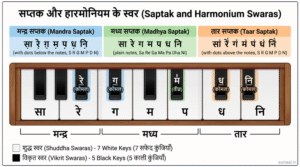
3. Standard Harmonium Fingering Sequences
A. Playing from First White Key — C (पहली सफ़ेद)
-
Aaroh (Ascent):
Sa (1) – Re (2) – Ga (3) – Ma (1) – Pa (2) – Dha (3) – Ni (4) – Sa' (5) -
Avroh (Descent):
Sa' (5) – Ni (4) – Dha (3) – Pa (2) – Ma (1) – Ga (3) – Re (2) – Sa (1)
B. Playing from First Black Key — C# (पहली काली)
-
Aaroh (Ascent):
Sa (2) – Re (3) – Ga (1) – Ma (2) – Pa (3) – Dha (4) – Ni (1) – Sa' (2) -
Avroh (Descent):
Sa' (2) – Ni (1) – Dha (4) – Pa (3) – Ma (2) – Ga (1) – Re (3) – Sa (2)
4. Golden Rules for Smooth Fingering
-
Keep the Thumb Off Black Keys: Avoid placing your thumb (1) on the upper black keys whenever possible, as it twists the wrist and slows down fast passages (taans). Reserve the thumb primarily for the lower white keys.
-
Curved Fingers: Keep your fingers gently curved over the keys, never flat or stiff, and press each key cleanly from the fingertip without lifting your hand unnecessarily high.