

Understanding the Bhatkhande Notation System (भातखंडे स्वरलिपि पद्धति)
Developed by Pandit Vishnu Narayan Bhatkhande in the early 20th century, the Bhatkhande Notation System (Swarlipi Paddhati) is the standard written framework used across Hindustani classical music institutions, including Akhil Bharatiya Gandharva Mahavidyalaya Mandal (ABGMVM) examinations.
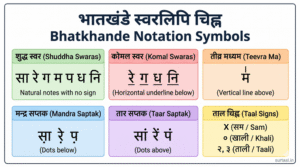
1. Identifying the 12 Swaras (Notes)
In every Saptak (octave), there are 7 Shuddha (natural) notes and 5 Vikrit (altered) notes—comprising 4 Komal (flat) notes and 1 Teevra (sharp) note:
-
Shuddha Swaras (7 Natural Notes): Written plainly without any diacritical marks or lines.
Notation: सा, रे, ग, म, प, ध, नि (Sa, Re, Ga, Ma, Pa, Dha, Ni)
-
Komal Swaras (4 Flat Notes): Only Re, Ga, Dha, and Ni can become Komal (lowered by a semitone). They are always indicated by a horizontal underline beneath the note.
Notation: रे॒, ग॒, ध॒, नि॒
-
Teevra Swara (1 Sharp Note): Only Ma (Madhyam) can become Teevra (raised by a semitone). It is indicated by a short vertical line placed directly above the note.
Notation: म॑
-
Achal Swaras (2 Immovable Notes): Sa (Shadja) and Pa (Pancham) never change their pitch—they have no Komal or Teevra variants.
2. Saptak (Octave) Indicators
Indian classical music recognizes three primary vocal and instrumental registers (Saptaks), distinguished by dots (bindu):
-
Mandra Saptak (Lower Octave): Identified by a dot placed directly below the note.
Notation: सा़, रे़, ग़, म़, प़, ध़, नि़
-
Madhya Saptak (Middle Octave): Written without any dot above or below the note.
Notation: सा, रे, ग, म, प, ध, नि
-
Taar Saptak (Upper Octave): Identified by a dot placed directly above the note.
Notation: सां, रें, गं, मं, पं, धं, निं
3. Time Duration & Melodic Ornamentation Symbols
-
Avagraha / Dash ( – ): Extends the duration of the preceding note by one matra (beat). For example,
सा –holds Sa for two full beats. -
Crescent / Ardha-Chandra ( ‿ ): Groups two or more notes together within a single matra (used in Dugun, Tigun, and Chaugun layakari). For example,
सा रे ‿means Sa and Re share one beat. -
Meend (
⌒above notes ): A smooth, unbroken glide from one note to another without breaking the sound. -
Kan Swara (Grace Note): Written in smaller font slightly above and to the left of the main note (e.g., पध), indicating a delicate touch of the grace note before landing on the principal note.
4. Taal & Rhythm Markers
-
Vibhag Bar ( । ): A vertical line separating rhythmic divisions (Vibhags) within a Taal cycle.
-
Sam ( X ): Marks the first and most accented beat of any Taal cycle.
-
Khali ( ० ): Marks the unaccented “empty” wave of the hand in a Taal cycle.
-
Taali ( २, ३, ४ ): Numbers placed beneath specific matras to indicate the 2nd, 3rd, and 4th claps of the Taal (since the 1st clap is always marked as X).